
This post is a follow up to the presentation titled “Frontier Firms Eat Spreadsheets for Breakfast: Project Controls in the Agentic Era”, that I gave at the Project Controls Expo in London November 2025.
Introduction
AI is already supporting project controls organizations with reporting, scheduling, simulations and risk management activities. But how far can it go?
- Will project controls organizations soon deploy AI workforces working alongside humans, or even replace human project controls professionals?
- Where are we on the path to the Agentic Era in Project Controls?
- What will it take to get there?
- What unique project controls challenges will require critical human judgment?
AI Data Center Capacity
Spending on AI capacity is “at epic level”, as WSJ recently put it. Data center capacity is often shown in GW due to power capacity being a fundamental limiting constraint, cost driver, and is key in determining how much compute a data center can run. According to JLL, data center capacity is projected to reach approx. 45 GW by 2030 – basically the same power demand as 45 million homes. MAMA (Microsoft, Alphabet, Meta and Amazon) spent nearly $90 billion last quarter alone, and Gartner predicts that worldwide AI spending will total $1.5 trillion in 2025.
Impact
With such unprecedent investment levels, there is little doubt that the impact will be felt, and we are starting to see the impact in the way work is done. How much it changes and exactly how is up to us as professionals in our fields.
Yes – we have made important breakthroughs, like mpwild, the most famous AI fat cat on tiktok, and we also have AI generated music stars (Glorb, FN Meka, Rayvn Lyte), actors (Tilly Norwood, Xicoia studio), AI meme generators and much more.
But AI is of course everywhere in daily life as well, sometimes hidden in the background and sometimes more front and center. This includes spelling and grammar checking, transcription, translation, product recommendations, air condition optimizations and many more areas.
Already now AI is outperforming humans in several benchmarks, according to Stanford’s AI index. This development is likely to continue as datacenter and model capacity keep improving.
Current State of Affairs
AI is already making its impact in project controls in narrow tasks. We see this in a number of areas:
- Schedule drafting, analysis, prediction and optimization
- Risk identification and mitigation
- Summarizing and writing of documents and reports
- Improve communication
- Revision comparison
- Tag extraction and mapping
- Lessons Learned analysis
- Resource optimization
But your boss keeps asking for more! Pressured by his peers who are bragging they can keep growing at 20% annually without adding headcount, she wants to know what are going to do next?
AI Agents
This leads us to the latest evolution, which is AI Agents. AI Agents go beyond prompting, assistance, and automation – an AI Agent is goal-oriented, senses, reasons, and acts autonomously. According to Microsoft, they are “systems that observe their environment, interpret data, and act toward specific goals.”
Designed to support people they are used to reduce repetitive work, improve accuracy, and guide faster decisions. Some follow clear, rule-based instructions, while others learn and adapt over time.
And the expectations are high:
- Sam Altman calls it “the Next giant breakthrough”
- Bill Gates says “Agents are (…) bringing about the biggest revolution in computing since we went from typing commands to tapping on icons”
- Satya Nadella says “AI agents will become the primary way we interact with computers in the future”, and
- Jeremy Jurgens, Managing Director World Economic Forum, says “AI agents can become invaluable allies in fostering innovation and improving quality of life worldwide.”
Not surprisingly, Gartner says AI Agents are now at peak hype in their Hype Cycle. Some people write that off and use that as confirmation this is only hype. But when you look carefully about what they say, Gartner says they expect that it will be “2-5 years until AI Agents has matured enough to demonstrate real, tangible value and is being widely adopted in mainstream markets (reaches plateau of productivity)”.
Think about that for a moment. This means that in 2-5 years, your competitor is reaping real, tangible value from AI Agents. And some are actually already there, like SLB, Equinor and Walmart. How will you adapt to AI and the Agentic Age when it comes to project controls? The time to start preparing is now.
Frontier Firms
Microsoft released their vision for how this will play out over the next few years. In their report coined “2025: The year the Frontier Firm is born” , they introduced the term Frontier Firm. “A new organizational blueprint is emerging, one that blends machine intelligence with human judgment, building systems that are AI-operated but human-led. Structured around on-demand intelligence and powered by “hybrid” teams of humans + agents, these companies scale rapidly, operate with agility, and generate value faster”.
Further, similarly to Gartner’s prediction, they believe that in the “next 2–5 years we expect that every organization will be on their journey to becoming” a Frontier Firm.
Impact on Project Controls
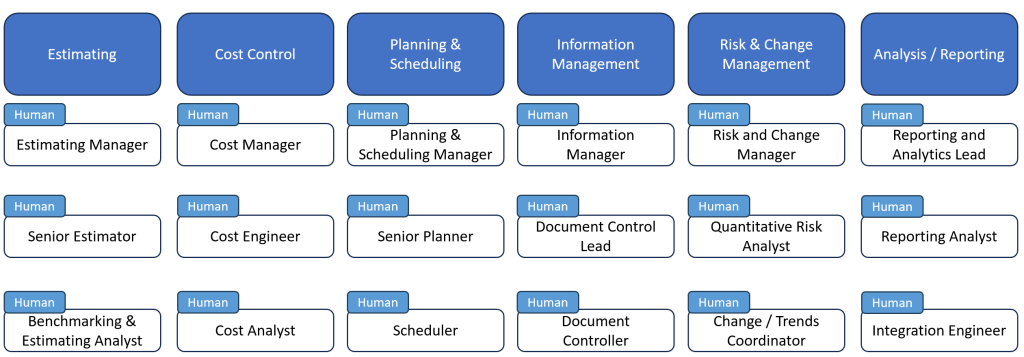
How will agentic capabilities impact project controls, which today is 100% human operated (with assistance from tools, of course)? See chart below for an illustration of project controls today:
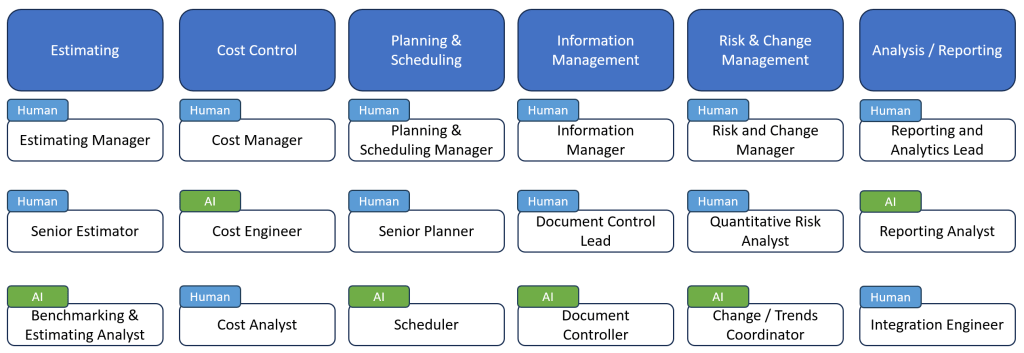
Are we moving towards something like this:
or this?
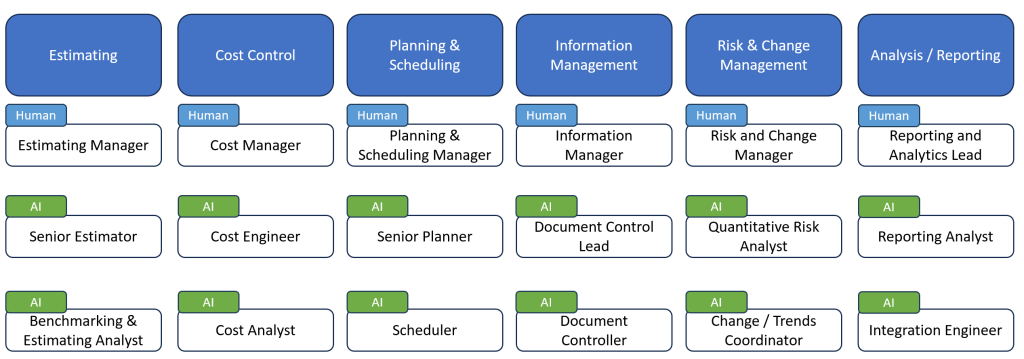
or even this?

In this scenario, can we see project controls teams of one, or a core team handling 10x more projects than today? Or are we even seeing Self-operating project controls team that scale and escalate as needed, continuously learning and adapting?
I believe the most likely scenario in the foreseeable future is something like this:

The reality is that each project controls function performs hundreds of distinct tasks, and is dealing with highly dynamic situations.
That’s why the pathway goes through specializations – agents supporting with specialized narrow tasks, that later are combined into a larger whole.
What is certain is that that the work of project controls is changing.
Realizing Value from AI Agents
With so much buzz and opportunity it is easy to become paralyzed and not know how to get started. Many choose to carry on business as usual. However, they also risk that the words of Nokia’s CEO come haunting. In his final speech to his employees in 2013, Stephen Elop famously said “We didn’t do anything wrong, but somehow, we lost.”
So I recommend acting now, and get started.
The process is not dissimilar to any other major improvement or digital transformation effort.
- Identify Use Cases
- Shore up the Data Pipelines
- Establish the Tools, Security and Governance Practices
- Experiment, Learn and Refine
Identify Use Cases
At our global Omega 365 User Conference earlier this year in Calgary, we asked our audience of over 250 project controls about where they wanted AI to help. The results was grouped into categories as follows. This can serve as inspiration to get you started thinking of your specific context and your specific use cases.
Predictive Forecasting & Risk Intelligence
- AI-powered cost forecasting and risk prediction
- Timeline projection based on delays, resource shifts, and critical path impact
- Early detection of fabrication risks and NCRs
- Classification and categorization of projects to improve baseline forecasting
- Automated EV analysis and project performance review
- Predictive variance explanations (cost/schedule)
- Scenario planning and “what-if” simulations
- Forecasting punch item trends and contractor performance
- AI coding of cost accounts to schedule elements
Smart Document & Data Automation
- AI-driven document and drawing interpretation to extract key information
- Intelligent sorting and registry for document control
- Model review and completeness checks
- Automated document and tag metadata validation
- Real-time capture of mark-ups and revisions
- Advanced search and AI answers from project documentation
- AI assistance for contract and transmittal processing
- Automated support from initiation to close-out
Automated Reporting, Workflows & Quality
- AI-driven dashboards with drill-downs and variance explanations
- Automated cost and progress reporting
- Workflow creation from natural-language prompts
- Contractor time management automation
- Data quality validation and anomaly detection
- Change management alerts
- Auto-flagging incomplete submissions and bottlenecks
- AI scoring of qualitative PM comments for reporting accuracy
Knowledge Collaboration
- Interactive AI help replacing static user guides
- Agentic UX layer that performs actions on behalf of the user
- Predictive prompts and context-aware suggestions
- Adaptive interfaces to reduce manual navigation and training
- AI-enhanced community forum and shared best practices hub
- Knowledge capture and smart routing of project information
Shore up the Data Pipelines
The Economist on May 6th, 2017 declared “The world’s most valuable resource is no longer oil, but data”. This is one of the rare occasions where a quote has aged really well, and is even more true today than back then. AI agents need data – lots of data, and data of high quality data.
Many project controls organizations have improved their data capture and refinement, but many still have limited and poorly organized data. A prerequisite to take advantage of AI and AI agents is to first move from ad-hoc silos to integrated solutions with properly structured and integrated data, which Omega 365 provides.
You also need to ensure that you have the other data pipelines and APIs setup – to leverage agentic capabilities it is no longer enough to move data – you also need to be able to let the agents autonomously trigger and execute actions.
Tools, Security and Governance Practices
First, lets recognize that not all problems are best solved with AI or AI agents. However, many are, and you should explore it. As you do, one of the first obstacles you have to overcome is skepticism. Are you ready to let AI decide for you? When are you ready to let AI decide for you on matters of importance? And you will walk right into organizational turf wars – who controls the data and what you can do with it?
You also have to address how to handle validations, exception situations and escalations: Your agent needs to know when to escalate to a human processor. And one agent will need to provide input to another human or even agent (referred to as Multi-Agent Systems) – how are they each going to communicate and in which format for optimal execution?
Goal misalignment is another key concern. If you tell your human project controls team that you want your project to achieve its objectives, within an acceptable range of cost, schedule and within the quality and safety requirements, your team makes a lot of tacit considerations and decisions. Your AI or AI Agent does not have this capability and could make assumptions about project situations that are misaligned with your unstated goals. You need to put in place significant guardrails to protect your organization.
When it comes to your teams, will overreliance cause organizational loss of knowledge or capability? Or the opposite? What if the system fails?
Experiment, Learn and Refine
AI and AI Agents don’t understand the world like we do, as it primarily makes predictions based on past patterns. Neither does it have the secret sauce we call “common sense”, nor our deep ethical reasoning capability.
Combine this with the fact that Project Controls professionals perform hundreds or even thousands distinct tasks covering a number of disciplines, and deal with highly dynamic situations on a daily basis – and you realize that the pathway to agentic project controls go through specializations. You start with agent supporting specialized narrow tasks, that are later combined into a larger whole.
This takes experimentation – with data, prompting, outputs and constant refinement.
Measuring
Project Controls professionals are used to establishing baselines and measuring. So how do you measure progression towards agentic project controls? You can take inspiration from various models, including Society of Automative Engineers’ SAE J3016 Levels of Driving Automation, or the Agentic AI Progression Framework as presented by the authors of the book titled Agentic Artificial Intelligence.
Here I suggest 5 levels of sophistication for a Project Controls Agent as follows:

Conclusion
Project Controls is not disappearing but is being reshaped by the advances in AI and Agentic AI. Expectations are rising rapidly, and it is important to recognize that “for certain tasks, AI agents already demonstrate expertise comparable to humans but can deliver results significantly faster and at a lower cost.” (AI Index Report 2025, Stanford).
How are you reshaping your project controls processes to leverage the new capabilities to drive better project outcomes? I will close with Mark Twain’s words: “The secret of getting ahead is getting started”.
 Vik Bulletin